Bernarda’s enforced eight-year mourning
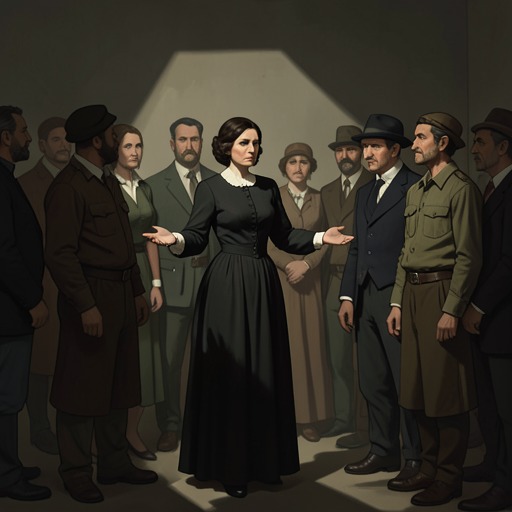
The House of Bernarda AlbaBernarda’s enforced eight-year mourning is more than a response to a death: it is a rule imposed on her daughters that seals the household against the outside world and directs their lives toward obedience and sewing. The decree lasts three years beyond the customary five-year mourning period for a close family member. At the play’s end, Bernarda’s return to the command with which she began completes a circle of silence and enclosure.
The Decree and Its Daily Consequences
Bernarda announces that mourning will last eight years and imagines the doors and windows bricked shut so that not even the street wind can enter. She invokes the same practice in her father’s and grandfather’s houses, presenting the confinement as inherited custom rather than a choice open to her daughters. The duration itself is punitive: eight years exceeds the customary five and illustrates Bernarda’s severity, perhaps also her wish to surpass the other villagers.
The decree governs the daughters’ daily activity as well as their movement. Bernarda orders them to begin embroidering their trousseaus and says that she has twenty pieces of linen in a chest for sheets. Magdalena responds that it makes no difference to her; Adela sharply tells her that if she does not want to embroider her sisters’ trousseaus, she should leave them plain. The work gives the enforced mourning a domestic routine and ties the daughters’ restricted future to marriage preparations, even as the decree keeps them inside.
Custom, Gender, and Household Authority
The play situates mourning within village customs that include ritual responses to death and the division of social life between men and women. Bernarda’s command intensifies that context: while the daughters are confined to domestic work, men retain greater freedom. The household’s established gender roles are summarized in Bernarda’s maxim, “A needle and thread for women. A whip and a mule for men.” Mourning thus reinforces an order in which the daughters’ place is inside the house and their allotted work is sewing and embroidery.
The house’s substantial walls and clearly defined interior spaces make the enclosure concrete. In Act Three, the yard, stable-yard, and stables become the focus of movement, while the daughters remain subject to the rules Bernarda has imposed. Her order that the wind from the street shall not enter turns a physical boundary into a declaration of authority: the mourning period is to govern the household’s relation to the world beyond it.
Reputation and the Final Command
The play connects domestic discipline to the fear of public judgment. Bernarda insists that the neighbors must not hear her daughters arguing, and her concern for the family name culminates after Adela’s death, when she orders that the villagers be told her daughter died a virgin. The demand makes reputation a matter to be managed even in grief, and exposes the difference between the household’s public account and the truth Bernarda seeks to suppress.
At the close, Bernarda again commands silence. Her first word in the play is also her last; alongside the bells that open the action and are to toll again at daybreak, the repetition gives the drama a circular structure. The eight-year rule therefore belongs to a larger pattern of enclosure: mourning does not open into release but returns the household to silence, with the daughters’ lives still controlled by Bernarda’s authority.